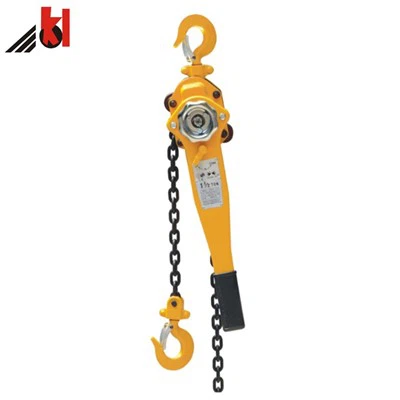
There are many types and specifications of lifting tackle, generally single wheel tackle is mostly used for lifting, guiding, balancing, and other occasions, while multi wheel tackle is mostly used to form lifting and traction tackle groups. The general requirements for the use of lifting tackle are as follows:
1. The common single wheel tackle is mostly an open end type, with two types of connecting parts: hook and ring type. The hook or ring type can rotate, so there is no directionality when hanging. When using, first pull the hook or ring, open the opening baffle on the protective plate, place the steel wire rope into the groove, and then lift the pulley to lock the baffle. If used on the ground or if the pulley will bend itself when not under force, it should be checked at any time to ensure that the opening baffle is locked.
2. The commonly used multi wheel pulleys are non opening type, with rotatable and fixed lifting rings at the connecting parts. The fixed lifting ring pulleys have directional suspension, and when the pulleys are under force, they should not be subjected to torsion. Otherwise, U-shaped rings should be added for adjustment.
3. In situations where the direction of force changes significantly or when using a single wheel pulley at high altitudes, a ring type pulley should be used. If a hook type pulley is used, sealing and safety measures must be taken for the hook. Due to repeated force on the hook type pulley, it is easy to detach from the binding rope.
4. When using an open door pulley, the door buckle must be securely locked.
5. The sealing plate of the hook or pulley hook should be installed properly. If the sealing plate is damaged or lost, the hook should be sealed with 10 # iron wire, and the binding rope should not be tied to the hook with iron wire.
6. To prevent the hook or ring of a single wheel pulley from twisting the traction rope due to mutual rotation with the pulley group during the force process, the hook or ring should be securely tied to the protective plate using a No. 8 iron wire.
7. Safe lifting and use according to the factory nameplate, without overloading.
8. Before use, a visual inspection must be conducted. Any hooks, rings, protective plates, partitions, etc. that have severe deformation and cracks, damaged wheel flanges, deformed bearings, worn bearing shells, and inflexible rotation, incomplete components, and unknown tonnage must not be used.